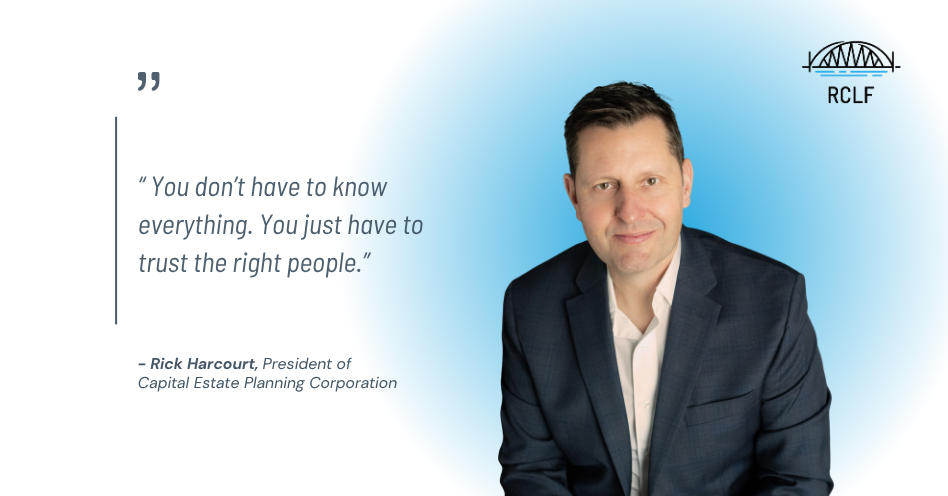
“I would say… you don’t have to know everything. You just have to trust the right people.”
In an industry where most people feel overwhelmed before they even begin, Rick Harcourt has built his company on something far simpler and far harder to earn: trust.
Because at the end of the day, he believes that it’s not about every detail, it’s about finding someone you trust to guide you toward the right decisions, even when it’s not the easiest path.
Rick shared a moment that, on the surface, might seem routine in the benefits industry.
When a group benefit renewal comes in, costs naturally increase. And most times, it’s the kind of increase most companies just look at, accept, and then pass along their clients without question.
But instead of accepting it, Rick and his team go back.
They challenge the numbers, rework the plan, and push for something better, even if knowing the outcome won’t necessarily benefit them.
Because to Rick, the decision isn’t about revenue. It’s about responsibility.
“We’re always going to do what’s right for the client, even if it’s not right for us.”
Over time, those quiet decisions become the foundation of something much bigger: a level of trust that keeps clients coming back, not out of obligation, but out of confidence. And maybe without even realizing it, a healthier work culture.

For years, Rick carried the weight of being the one who had to step in.
So when Rick took a fully unplugged trip, he was anxious about coming back, expecting a flood of decisions waiting for him, emails only he could answer, and problems only he could solve. But when he returned, everything had already been handled.
His team had stepped in, supported clients, and made decisions with the same level of care he would have.
And in that moment, it became clear that the trust he had built outwardly had also taken root internally.
“I am very fortunate to have an incredible team who just care like crazy about our clients and they’re all long-term too. I think our most recent person had their four-year anniversary with us, and we’ve got people who’ve been with the organization for decades. And it’s because they care about their clients and the people we work with, and (with) that level of responsibility… It’s a very lucky place to be in.”
Earlier in his career, growth meant numbers. Whether that’s more revenue, more clients, or more momentum.
But over time, that definition shifted.
“So I think that in the past, it was easy to get caught up on top line growth (revenue) like seeing just sales growth. And I went to a session where the speaker used this line, ‘revenue is vanity’. So talking about how much you’ve grown in terms of revenue… Yes, sure. Feels good….
But growth, if you’re not profitable and if you’re not doing the right things by people, isn’t really useful as a number.”
So if that’s not useful, then what is?
Instead of chasing numbers, Rick focused on serving better and looked at the small pieces that completed the bigger picture.
He looked at his company’s retention rate and the care they put on making decisions that made sense for the people he worked with.
And by focusing on these, he saw that there was still growth.

Many of the lessons Rick carries didn’t come easily.
They came from his experiences. Both the successes and the failures.
But what stood out most was how much could be learned from others willing to share their own experiences, especially the difficult ones.
“You can’t necessarily talk to your spouse in all circumstances because it might stress them out. You can’t talk to your staff about it because your decisions you make could affect them.
So having that kind of support network can be a really, really valuable thing for anyone leading an organization.”
When leadership can feel isolating, learning from other people’s experiences doesn’t just give you insight, it also reminds you that you aren’t alone.
Because through those conversations, Rick realized that he wasn’t just learning something new, he was also being reminded that these are challenges many leaders quietly face, and that he’s not the only one navigating them.
That’s what makes spaces like RCLF valuable.
Many of the lessons Rick carries didn’t come easily.
They came from his experiences. Both the successes and the failures.
But what stood out most was how much could be learned from others willing to share their own experiences, especially the difficult ones.
“You can’t necessarily talk to your spouse in all circumstances because it might stress them out. You can’t talk to your staff about it because your decisions you make could affect them.
So having that kind of support network can be a really, really valuable thing for anyone leading an organization.”
When leadership can feel isolating, learning from other people’s experiences doesn’t just give you insight, it also reminds you that you aren’t alone.
Because through those conversations, Rick realized that he wasn’t just learning something new, he was also being reminded that these are challenges many leaders quietly face, and that he’s not the only one navigating them.
That’s what makes spaces like RCLF valuable.
After years of building the business through relationships and trust, Rick’s focus now is on telling their story more openly and helping more people understand what they actually do.
For a long time, most of their growth came naturally through referrals and long-term client relationships. But now, with a growing team behind them, they’re working on expanding their outreach and finding new ways to connect with people who may need support but don’t know where to start.
Through years of working with teachers and clients across Alberta, Rick has also seen how financial literacy doesn’t always come easily to people. That’s why his team focuses heavily on simplifying conversations around savings, retirement, and financial wellness into something approachable and realistic for everyday life.
At the end of the day, Rick and his team’s goal is to help people feel supported, understood, and a little more confident about their future.
Rick Harcourt’s story is a reminder that leadership isn’t defined by the big moments. But rather, it’s defined by the quiet and consistent decisions based on their values and mission.
The type where you choose trust over convenience, relationships over short-term gain, and people over everything else.
And over time, those choices shape not just a business, but the kind of leader you become.
At RCLF, we’re proud to highlight leaders like Rick who lead with integrity, care, and long-term thinking.
Because sometimes, the best way to grow as a leader…
is simply to hear how someone else got through it.
Explore membership with RCLF today! Learn more about RCLF here: https://rclf.ca/join-us/