
Emily Ruttan on Why Good Leadership Starts With Listening
What if leadership wasn’t about shaping an organization around yourself, but allowing yourself to be shaped by the values that existed long before you?
For Emily Ruttan, CEO of Winifred Stewart in the past 5 years, those values existed long before she stepped into the role.
For more than 75 years, Winifred Stewart has supported people with developmental disabilities in building lives with greater independence, purpose and belonging.
As Emily puts it, people that have developmental disabilities want the same things as everyone does: mental and physical health, a safe place to call home, purpose and community.
Just like we want the same things, we also all have received support in our lives. Walking alongside someone to help build a good life raises a surprisingly complicated question:
Who gets to decide what a good life actually looks like?
The individual being supported should guide that journey.
The Problem With the Golden Rule
We’ve all heard the phrase: “Do unto others as you’d have them do unto you.” but Emily challenges it.
“The problem with the golden rule,” she says, “is do unto others as you’d have them do unto you. Fundamentally, I don’t believe in that rule.”
Instead, she believes we should listen and find out what works for someone and respond to that, rather than assuming what works for us will work for them too.
That distinction is embedded directly into how Winifred Stewart operates. Its vision is for people with diverse abilities to have a voice, a choice and a place to belong throughout their lives. One of its core values is equally direct: make decisions with people, not for people.
And Emily takes the idea of choice further.
“I have a deep belief that people need to be given opportunities to have real choice(s)… Real choice isn’t not knowing what your options are and being asked to choose something. Real choice, I think, dovetails into a concept that I think as adults we can talk about even more. And that’s the role of experimentation and trying things on.”
In other words, real choice requires options, being well-informed, and the freedom to experiment before deciding.
It changes the leader’s role from I know what’s best for you to help me understand what’s important to you.
And that requires listening, especially when you don’t like what you’re hearing.
Resistance Isn't a Problem
Emily has another unconventional belief:
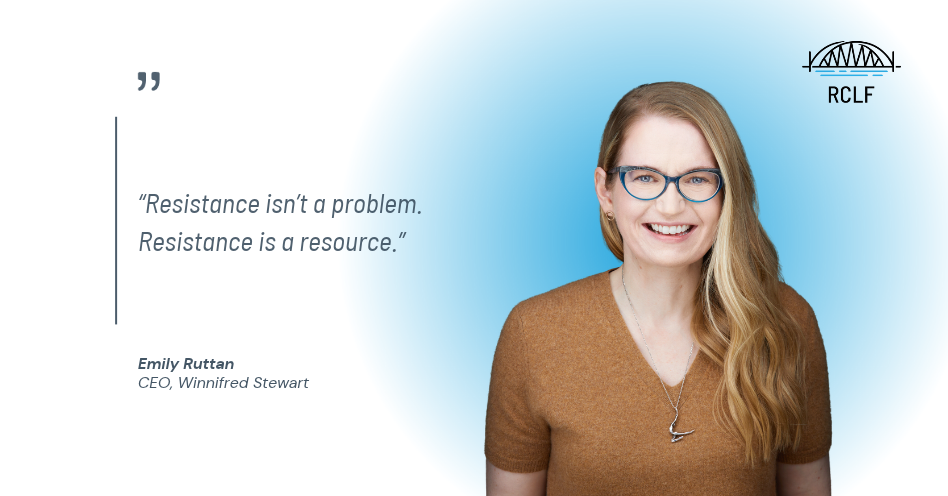
Resistance is a resource.
When someone tells her why they don’t like an idea or why something won’t work, her instinct isn’t to rebut them.
She becomes curious.
“Interesting. Tell me more. Help me understand this. Where is this coming from?”
Because resistance tells her something. It can reveal what someone values, what they’re worried about and where there may still be common ground.
That approach has followed Emily throughout her career, from teaching high-risk youth to working in remote Northern Alberta communities to leading an organization of approximately 300 employees today.
Her question has remained remarkably consistent:
What is already working that we shouldn’t lose? What isn’t serving us? Who is missing? And how do we bring them into the conversation?
Curiosity, in that sense, isn’t passive. It’s part of how decisions get made.
You Don't Know Your Values Until They're Tested
“You don’t know your values until you’re tested”, Emily confidently stated.
Throughout her career, Emily has encountered decisions that challenged what she or her company believed in. Those moments tested whether she was willing to stand by those values, even when doing so wasn’t the easiest choice.
Today, values form the frame through which she leads, and she believes they’re the foundational factor to many different variables or inputs.
“You have to have data. You have to talk to different stakeholders. There’s all sorts of different things that affect decisions.
But knowing your values is the frame.”
That becomes especially important when leading a 75-year-old organization with more than 10 sites and approximately 300 employees.
Afterall, not-for-profits are still businesses.
They carry financial obligations, operational complexity and risk. Good intentions alone won’t preserve a mission for another 10, 20 or 40 years.
The challenge is making strong business decisions without losing sight of why the organization exists in the first place.
For Emily, Winifred Stewart’s values provide that frame: make decisions with people, challenge the status quo and build community one connection at a time.
Build a Life, Then Let Work Fit Around It

Emily’s values don’t stop when the workday does.
For years, she says she waited until she had enough time to have a life.
Eventually, she realized that time wasn’t coming.
“For years up to my mid-30s, I waited to have time to have a life.
And I realized I was never going to have time to have a life because I was always working. I had to have a life and then work had to fall in around it.”
She calls her approach a wedge strategy.
For Emily, that means deliberately putting hiking, paddling, biking, camping, travel and other intense experiences into her life rather than waiting for work to leave room for them. The key of these experiences is that she connects with family and friends while doing them.
Those experiences pull her completely out of work mode and remind her that she’s more than her role. Then she returns with renewed focus.
It’s part of another leadership belief Emily has learned over time:
You cannot lead others if you cannot lead yourself.
Build a Life, Then Let Work Fit Around It
Emily’s values don’t stop when the workday does.
For years, she says she waited until she had enough time to have a life.
Eventually, she realized that time wasn’t coming.
“For years up to my mid-30s, I waited to have time to have a life.
And I realized I was never going to have time to have a life because I was always working. I had to have a life and then work had to fall in around it.”
She calls her approach a wedge strategy.
For Emily, that means deliberately putting hiking, paddling, biking, camping, travel and other intense experiences into her life rather than waiting for work to leave room for them. The key of these experiences is that she connects with family and friends while doing them.
Those experiences pull her completely out of work mode and remind her that she’s more than her role. Then she returns with renewed focus.
It’s part of another leadership belief Emily has learned over time:
You cannot lead others if you cannot lead yourself.
The CEO Doesn't Need to Have All the Answers
When Emily first became a CEO, she thought part of her job was having most of the answers.
Experience changed that.
She still believes leaders need to be informed and do their homework. But sometimes the CEO’s most important contribution isn’t walking into the room with the solution.
It’s creating the space for someone else to find it.
“I think what I’ve learned is that my job is sometimes just to create the space for others to have answers.”
That means listening, facilitating and bringing people into the challenge rather than always positioning herself as the expert.
It also means having people around her who can challenge her thinking.
That’s part of what she has found through RCLF.
“My CEO peer group has been an amazing group of people. I have so much respect for them as leaders and as family people.
And so it’s really a privilege, honestly, to be sitting in the same room with them where we have created a safe space to really be vulnerable and to support each other.
And that’s very special.”
Instead of one person being positioned as the expert with the answer, peers bring their own experiences into the room and work through the challenge together.
For a leader who believes so deeply in making decisions with people rather than for them, perhaps it’s fitting that the leadership community she chose works much the same way.
“Peer support is a model that supports healthy communities– not everyone has access to peer support. Volunteering as a Board Member of the Canadian Mental Health Association -we have been growing the reach of peer support networks as peer support is a fundamental part of supporting mental health fitness.”
Building What's Next
Now, some of the initiatives that Emily is part of could help shape Winifred Stewart well beyond her own tenure.
The organization is planning their next Capital Project: a large mixed-use housing project that could provide homes for more than 100 people and potentially become a model that could scale across Alberta and beyond.
But once again, Emily isn’t thinking only about putting a roof over someone’s head.
“You can have people living somewhere in four walls, but how do you activate that space so that people are connected?”
How will residents know their neighbours? Where will they gather? Can they access nature? Is the community walkable? How can specialized, affordable and market housing exist together?
Those questions bring Emily’s philosophy full circle.
Whether she’s thinking about housing, leading 300 employees, sitting with her RCLF peers, advancing community based mental health or listening to someone who disagrees with her, leadership isn’t about having the perfect answer.
It’s about staying curious enough to ask better questions, grounded enough to know what you stand for, and open enough to let other people help shape what happens next.
Because sometimes the most important thing a leader can do isn’t to decide for everyone else.
It’s to make room for them in the decision.
Grow Your Network and Connect with RCLF
At RCLF, we’re proud to highlight leaders like Emily who lead with curiosity, care, and long-term thinking.
Because sometimes, the best way to grow as a leader…
is simply to hear how someone else got through it.
Explore membership with RCLF today! Learn more about RCLF here: https://rclf.ca/join-us/